What Really Works to Treat Sleep Apnea?
Obstructive sleep apnea affects millions of people worldwide, leading to fatigue, poor concentration, and even serious long-term health risks such as heart disease. The good news is that a variety of treatment options exist for this disorder. However, choosing the right sleep apnea treatment can be tricky. Examining the clinical effectiveness of each option is important, but so is considering which treatment for sleep apnea is comfortable to use and fits your lifestyle.
Even the best sleep apnea treatment won’t work if you don’t use it consistently. That’s why we created the Daybreak Device, and that’s also why we put together this guide to help you choose the best treatment option for your needs.
<figure style="display: block;max-width: 800px;margin: 0 auto;padding: 0;border: none;">
  <a href="https://www.thedaybreak.com/resources/what-really-works-to-treat-sleep-apnea">
    <img src="https://www.thedaybreak.com/images/resources/WhatWorkstoTreatSleepApnea.jpg" alt="What Really Works to Treat Sleep Apnea? — Infographic"
      title="What Really Works to Treat Sleep Apnea? — Daybreak — Infographic"
      style="display: block; width: 100%; height: auto; border: none;">
  </a>
  <figcaption style="margin-top: 6px;">
    by <a href="https://www.thedaybreak.com/" title="Daybreak Sleep Apnea Treatment">Daybreak</a>
  </figcaption>
</figure>Common Sleep Apnea Treatments Explained
Sleep apnea treatment isn’t one-size-fits-all. Each approach works in a different way to keep your airway open and help you breathe normally during sleep.
- CPAP (continuous positive airway pressure) machines deliver a gentle stream of pressurized air through a mask, keeping your airway open all night.
- Oral appliance therapy uses a custom-fitted mouth guard that repositions your jaw and tongue to prevent airway collapse.
- Surgery for sleep apnea can remove or reshape tissue that blocks airflow or adjust the structure of the airway. Options include procedures like uvulopalatopharyngoplasty, which removes excess tissue in the throat; nasal surgery to correct structural blockages; or implantation of a nerve stimulator that repositions the tongue during sleep.
- Lifestyle and positional therapy focuses on behavioral changes, such as losing weight, avoiding alcohol before bed, or sleeping on your side, to reduce obstruction naturally.
How Effective Are Sleep Apnea Treatments?
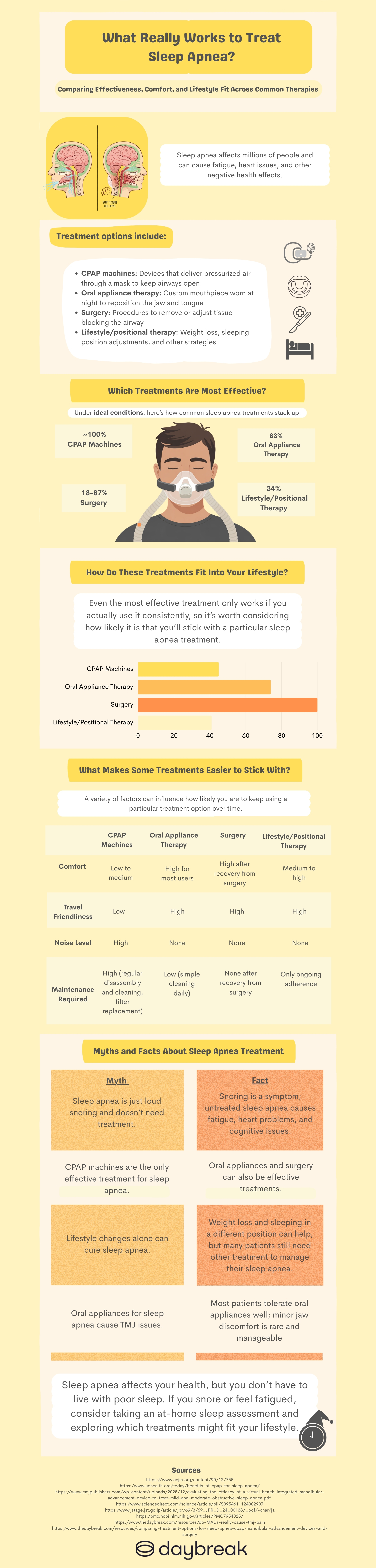
Under ideal conditions, using a CPAP machine for sleep apnea remains the most effective therapy, preventing airway collapse nearly 100% of the time when used consistently as directed. Using an oral appliance for sleep apnea is effective for 83% of users, while the effectiveness of surgery varies widely, from 18% to 87%, depending on the specific surgery performed and the patient’s anatomy. Lifestyle and positional therapy offer more modest improvement, with about 34% effectiveness on average. However, just looking at clinical effectiveness doesn’t tell the full story of whether a particular treatment will work for you.
Adherence: The Hidden Key to Real-World Success
Even the most effective sleep apnea treatment only works if you use it consistently. Adherence rates make a huge difference in how well a treatment option works in real life, outside of a clinical setting.
- CPAP Machines: About 45% of patients stick with using their sleep apnea machine long-term, often due to discomfort while wearing the CPAP mask, the noise the machine makes while it runs, and/or the amount of maintenance a CPAP machine requires.
- Oral Appliances: On average, 74% of users continue using their sleep apnea mouth guard regularly, the highest adherence rate among treatments that need to be used consistently to be effective.
- Surgery: Once recovery from sleep apnea surgery is complete, adherence is effectively 100%, since there’s nothing to use each night.
- Lifestyle and Positional Therapy: An average of 41% of people maintain self-care habits like losing weight or changing their sleep position over time.
What Affects Whether People Stick With Their Treatment?
How a treatment fits into your daily routine often determines whether you’ll use it every night. CPAP machines, while highly effective, can be uncomfortable, noisy, and bulky, especially when traveling. They also require regular cleaning and filter changes. Oral appliances, on the other hand, are comfortable for most users, small, travel-friendly, and easy to maintain. Surgery is invasive and requires recovery time, but after healing, it’s maintenance-free. And lifestyle changes like weight loss or positional therapy are simple and inexpensive, but they require consistent effort to be effective.
Here’s a quick comparison of common factors that affect usability:
| CPAP Machines | Oral Appliances | Surgery | Lifestyle/Positional Therapy | |
|---|---|---|---|---|
| Comfort | Low to medium | High for most users | High after recovery from surgery | Medium to high |
| Travel-Friendliness | Low (must bring bulky equipment and distilled water, then find a place to set it up and plug it in at night) | High | High | High |
| Noise Level | High | None | None | None |
| Maintenance Required | High (regular disassembly and cleaning, filter replacement) | Low (simple cleaning daily) | None after recovery from surgery | Only ongoing adherence |
Myths and Facts About Sleep Apnea Treatment
- Myth: Sleep apnea is just loud snoring.
Fact: Snoring is a symptom of sleep apnea, but it can be far more serious than that. Untreated sleep apnea can also lead to fatigue, heart disease, and cognitive problems. - Myth: CPAP therapy is the only effective treatment for sleep apnea.
Fact: Oral appliances and certain surgical procedures can also manage sleep apnea effectively. - Myth: Lifestyle changes alone can cure sleep apnea.
Fact: Weight loss and positional therapy help, but many patients still need additional treatments for sleep apnea. - Myth: Oral appliances cause TMJ issues.
Fact: Most users tolerate their dental device well, and only a small percentage experience mild, manageable jaw discomfort.
Find the Right Treatment for You
The best sleep apnea treatment can be different for each person, so the most important thing is to find one that works for you that you can stick with over time. If you snore, feel fatigued during the day, or suspect you may have sleep apnea, consider taking an at-home sleep test and discussing your options with a sleep specialist. With the right treatment, better sleep and better health are within reach.
Sources
https://www.ccjm.org/content/90/12/755
https://www.uchealth.org/today/benefits-of-cpap-for-sleep-apnea/
https://www.sciencedirect.com/science/article/pii/S0954611124002907
https://www.jstage.jst.go.jp/article/jpr/69/3/69_JPR_D_24_00138/_pdf/-char/ja
https://pmc.ncbi.nlm.nih.gov/articles/PMC7954025/
https://www.thedaybreak.com/resources/do-MADs-really-cause-tmj-pain